
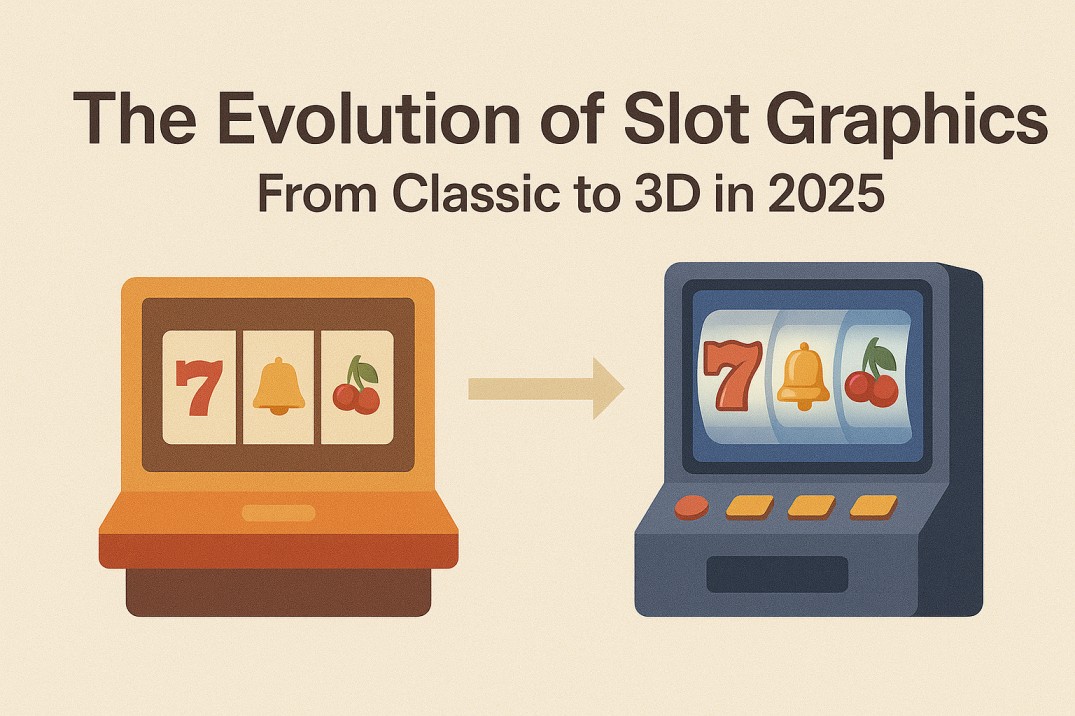
The visual experience of online slots has transformed completely in three decades. A player loading a slot on their phone in Singapore in 2026 is looking at something with more in common with a console game cutscene than with the mechanical fruit machines of the 1980s. Understanding how that transformation happened — and what it means for today's player — helps explain why certain providers dominate the Singapore market and others don't.
The Classic Era (1890s–2000s)
The Liberty Bell, invented in the 1890s, used physical reels stamped with horseshoes, bells, and playing card suits. Fruit symbols came later as an indirect consequence of anti-gambling laws — fruit-flavoured chewing gum prizes replaced cash payouts, and the symbols stuck. Electromechanical slots of the 1960s and 70s retained this visual vocabulary essentially unchanged.
When online gambling emerged in 1994, the first digital slots were faithful digital reproductions of this mechanical aesthetic: three reels, simple pixel-art symbols, flat colour backgrounds. Processing power was limited, bandwidth was slow, and the priority was functional gameplay rather than visual ambition. These early games did their job but offered nothing the mechanical originals hadn't already achieved visually.
The Video Slot Revolution (2000–2012)
The expansion to five-reel video slots opened up both payline complexity and visual space. Flash technology enabled animated symbols, bonus round sequences, and thematic environments that simple 3-reel games couldn't support. Developers began building genuine identities: Microgaming's Thunderstruck (2004) brought Norse mythology to life with animated characters; NetEnt's Gonzo's Quest (2011) was a landmark — fully 3D rendered characters, avalanche reels, and a cinematic opening sequence that felt genuinely different from anything before it.
This era established the template that most video slots still follow: thematic reel environment, animated win sequences, a distinct sound design palette, and a bonus round delivered with visual fanfare. The graphics weren't yet cinema-quality, but they were recognisably trying to be.
The 3D and Cinematic Era (2012–2020)
BetSoft's "Slots3" series pushed the envelope furthest in the early 2010s — fully 3D rendered characters with facial expressions, elaborate story-driven bonus sequences, and camera movements during wins that made each spin feel eventful. The production investment was substantial and the results showed: these games looked categorically different from anything that came before.
The transition from Flash to HTML5 in the mid-2010s was essential infrastructure: it made these rich graphics work across mobile devices without plugins or performance compromises. Portrait-mode mobile play became viable, and developers began designing for phone screens first rather than retrofitting desktop games for mobile.
Modern Era: PG Soft and Asian Animation (2020–2026)
PG Soft's rise has been the defining visual story of the current era for Singapore and the broader Southeast Asian market. Their approach combines Hollywood-quality 3D animation with culturally specific aesthetics — Fortune Tiger's animated tiger reacts to wins with genuine expressiveness; Mahjong Ways renders traditional tile textures with a detail level that wouldn't look out of place in a mobile game from a major studio.
JILI's fishing games take a different approach: real-time interactive graphics where players aim cannons and fish react dynamically to being hit. The visual language is more arcade than cinematic, but the execution is polished and the performance on mobile is excellent. For Singapore players accustomed to arcade gaming culture, this aesthetic lands differently — and more effectively — than a European-designed mythological slot.
Pragmatic Play in this period has focused less on graphic spectacle and more on mechanical elegance: clean cluster pays grids, clear multiplier displays, and particle effects during wins that communicate what's happening without overwhelming the player. Gates of Olympus looks good, but it's the clarity of its visual feedback — showing Zeus multipliers dropping, clusters forming, cascades rolling — that makes it genuinely easy to follow at speed on a phone screen.
What Singapore Players Expect Today
The bar in 2026 is high. Singapore players — majority mobile, majority portrait-mode — expect fast load times (under three seconds on a 4G connection), smooth animation at 60fps during wins and cascades, and graphics that scale cleanly from a compact phone screen to a tablet without blurring. Culturally relevant themes carry genuine weight: a well-executed mahjong or CNY theme outperforms a technically superior but culturally alien western-market title.
The providers who understand this — PG Soft, JILI, and increasingly Pragmatic Play with their Asia-focused titles — dominate the most-played lists at BK8, me88, and Maxim88. Visual quality matters, but cultural fit and mobile performance matter more.